

Two of the most-discussed technologies in clean energy have already been invented. Solid-state batteries work. Recycling the magnets out of dead electric motors works. Both have been demonstrated repeatedly in laboratories, published, patented and pitched to investors.
Neither is in your car yet, and the reason has almost nothing to do with chemistry. It has to do with a single manufacturing step that most people outside the industry have never heard of, and that step is currently the bottleneck for both.
The step where good materials go to die
Ceramics, advanced metals and battery components are not cast or machined. They are consolidated from powder. Loose grains get pressed and heated until they fuse into a dense solid, a process called sintering. For most of the last century it worked like an oven: put the powder in a hot chamber, wait for the heat to arrive, wait longer for the middle to catch up.
Waiting is where things break. Consider lithium lanthanum zirconium oxide, the garnet ceramic known as LLZO that most solid-state battery designs depend on as their electrolyte. It conducts lithium ions well and, unlike liquid electrolytes, it does not catch fire. To function it has to be almost perfectly dense, because every pore is a place where a lithium dendrite can start growing toward the other electrode.
Getting it dense requires heat. But lithium is volatile, and if you hold the material at sintering temperature for hours, the lithium simply leaves. It evaporates out of the ceramic you are trying to build. Conventional pressureless sintering and hot pressing both take long enough that you lose composition while gaining density. This is the manufacturing paradox at the centre of solid-state batteries: the process that makes the material work is the same process that ruins it.
The obvious fix is to stop waiting.
Heating the powder instead of the room
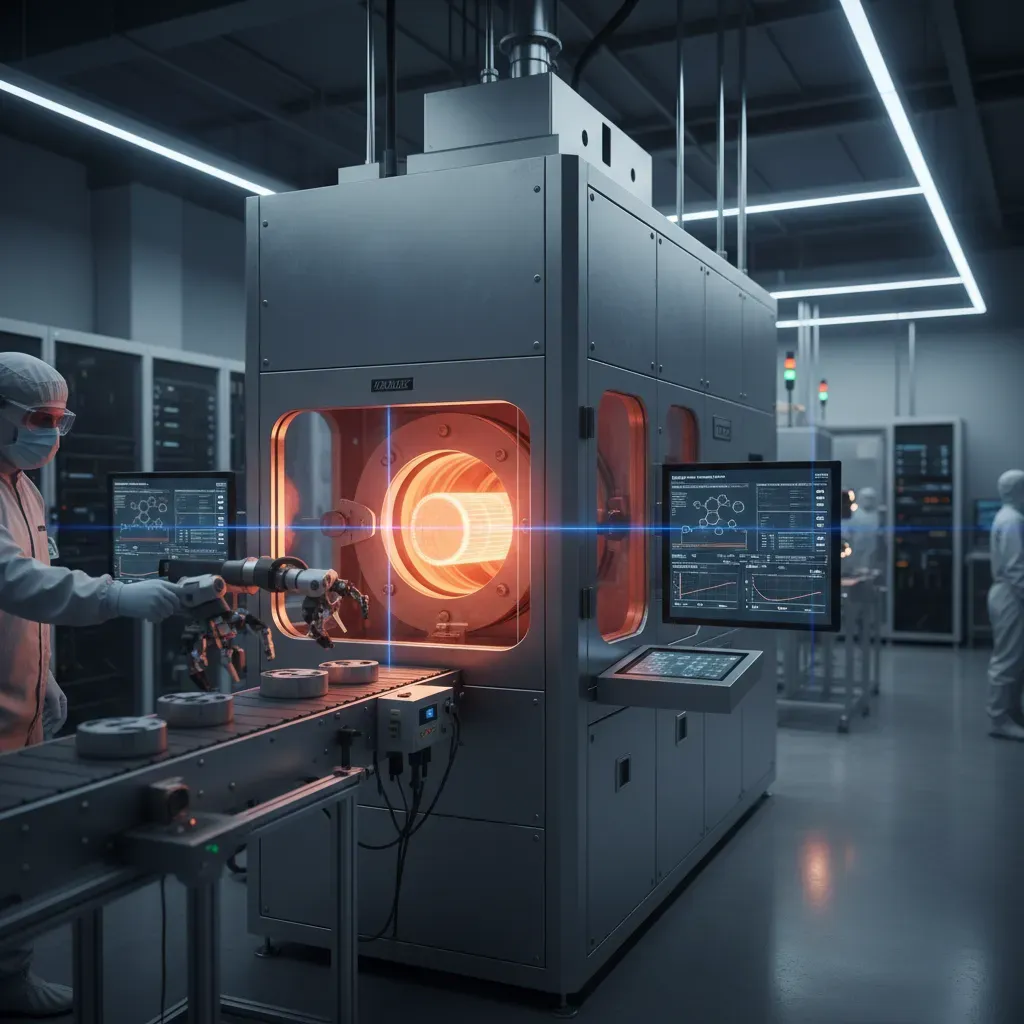
The technique that does this is known industrially as spark plasma sintering, and the principle is easier than the name suggests. Instead of heating a chamber and letting warmth travel inward, you pass a high-amperage pulsed electric current through the powder and the conductive die holding it, while a press squeezes from above. Electrical resistance is highest exactly where powder particles touch each other, so heat is generated at the points that need to bond rather than delivered to them from outside.
The consequence is speed. Heating rates run into hundreds of degrees per minute rather than single digits, and the hold at peak temperature is measured in minutes, sometimes seconds. Tantalum-doped LLZO can be densified at temperatures as low as 850 °C, or in a matter of seconds at 900 °C. Published work reports roughly 98 percent density reached in about five minutes, with room-temperature ionic conductivity above 0.45 mS/cm. The lithium does not have time to escape.
Worth noting, because the field is full of overclaiming: a 2025 comparative study in Small found that induction hot pressing can match spark plasma sintering on both density and conductivity when pressure and temperature are controlled carefully, and concluded that densification is predominantly governed by pressure-assisted heating rather than anything unique to the electric current. The name is also a historical artefact: early researchers thought electrical discharges created plasma between particles, whereas the dominant mechanism is now understood to be plain resistive heating. The technology is fast and industrially useful, not magic.
The other bottleneck: not mining what you already own
The second application is less about physics and more about geopolitics. Every electric motor and wind turbine contains neodymium-iron-boron magnets, and the supply chain for the rare earth elements inside them is concentrated in ways that make procurement officers nervous.
There is an alternative to mining more, which is recovering the magnets already installed in equipment reaching end of life. The obstacle has always been reconsolidating recovered magnetic powder into a working magnet without wrecking its microstructure through prolonged heating. Pulsed-current sintering handles this, and recent work on short-loop recycling combines hydrogen decrepitation with field assisted sintering to turn scrap motor magnets back into usable ones. Recycled magnets reach around 96 percent of the performance of newly manufactured equivalents.
The energy arithmetic is more striking than the performance figure. Recovering rare earth elements from end-of-life magnets and electronic waste consumes 75 to 85 percent less energy than primary production, and life cycle assessments of magnet-to-magnet recycling for EV motors report reductions in environmental impact between 64 and 96 percent depending on the category measured. That is not a marginal efficiency gain. It is the difference between a supply chain that depends on new mines and one that does not.
Why it took so long to matter
The fair criticism of this technology for thirty years was that it produced beautiful samples and unconvincing business cases. One part per cycle, an operator watching the press, no route to volume. Research groups loved it and manufacturing directors ignored it.
That gap is closing. Multi-chamber and automated configurations now keep the press working while other chambers load and cool, and for small components throughput of several parts per minute is achievable. Manufacturers of industrial sintering systems increasingly design around cycle time, automation and cost per part rather than laboratory flexibility. Real constraints remain, particularly thermal gradients in larger workpieces and carbon migrating from graphite tooling into the part, both of which have active engineering answers in hybrid heating and alternative die materials.
None of this produces a launch event. It shows up later, as a battery that does not need a cooling system or a motor built without opening a new mine. The unglamorous middle of the supply chain is where a surprising number of clean energy timelines are actually decided.
Among the companies working on this is GeniCore, a Warsaw-based manufacturer of pulsed-current sintering equipment and advanced composite materials, supplying systems from compact research units to multi-chamber production machines.