
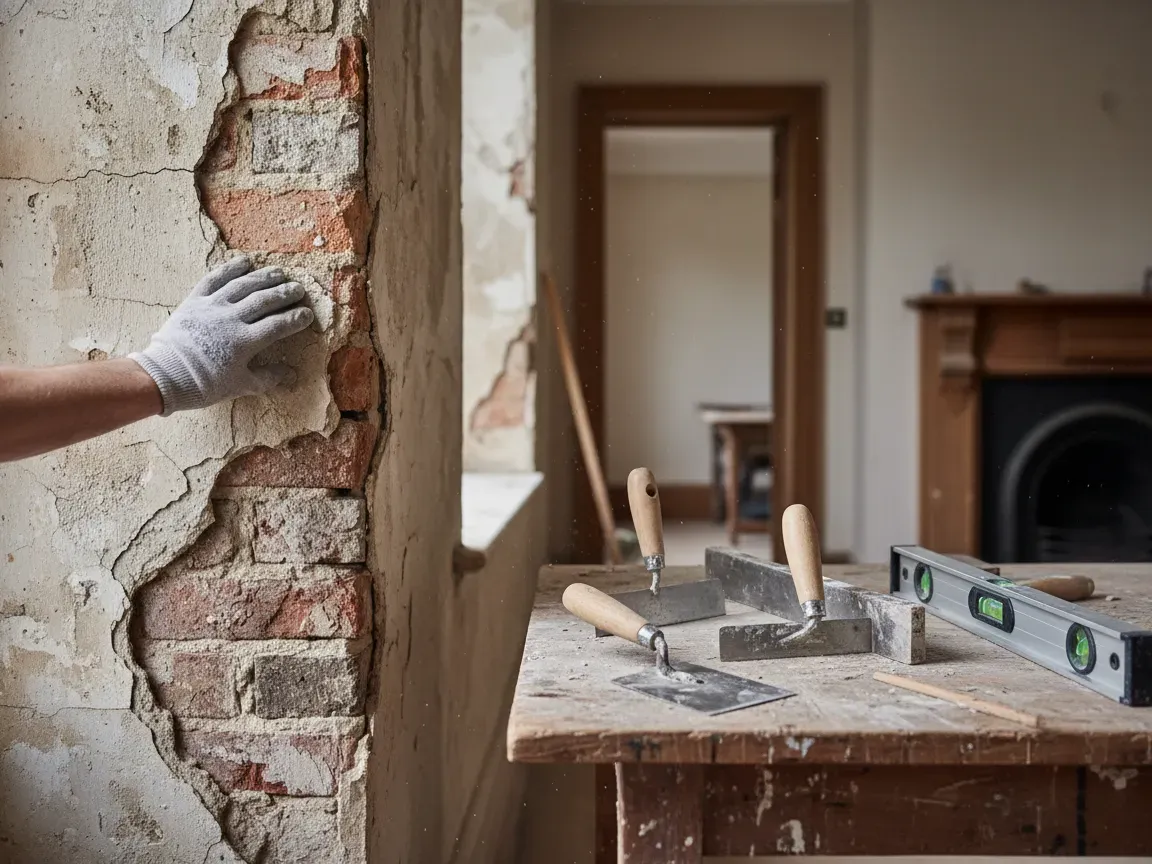

Re-Skim or Replaster? How to Read the Walls in a Croydon Home
A skim coat repairs a surface. Replastering repairs a wall. The difference matters because the wrong choice costs you the whole job twice: a fresh finish trowelled over plaster that has already lost its grip will crack, bubble or come away within a season, usually just after the room has been decorated.
Telling the two apart is not guesswork. There are checks any homeowner can run in ten minutes, and there are cases where the wall has to be opened up before anyone quotes a price.
Croydon housing stock makes the decision harder than it looks
The borough has no single wall type, which is why advice copied from a general DIY forum tends to fail here.
The Victorian and Edwardian terraces around South Croydon and Sanderstead were built with lime plaster on timber lath, three coats, the last one fine and soft. Lime moves with the building and tolerates moisture. Modern gypsum products do not behave the same way, and a hard cement backing coat slapped onto a lime wall usually shears off along the join.
The inter-war and post-war semis through Shirley, Coulsdon and Purley are mostly sand and cement render coats on brick or block, finished with a thin gypsum top. Sound, heavy, and prone to blowing in patches where the original mix was lean.
The flats and conversions near East Croydon station are plasterboard, either on dabs or screwed to metal frame. Nothing here is “plaster” in the traditional sense at all, and repairs are a board and tape job rather than a trowel job.
Work out which of the three you have before you decide anything else. In a converted terrace you may have all three in one property.
Four checks before you call anyone
Run these on the worst wall in the room, not the best one.
- The tap test. Knock across the wall with a knuckle every 300 mm or so. A solid, dull note means the plaster is still bonded. A hollow, drummy note means it has parted company with the brick behind it, even if the surface looks perfect.
- The crack pattern. Hairline map cracking is shrinkage in the finish and skims over happily. A single diagonal crack running from a corner of a door or window, wider at one end, is structural movement and needs looking at before any plasterer starts.
- The edge test. Press a fingernail into the plaster near a crack. If it crumbles to powder, the binder has gone and the wall is past patching.
- The corner check. Look at external angles and reveals. Chipped, rounded corners usually mean missing or rusted beads, and beads have to be reset before a finish coat will hold a line.
If more than a third of a wall sounds hollow, you are replastering that wall, not skimming it.
When a skim coat is the right answer
Skimming works when the background is flat, sound and dry, and the problem is cosmetic: tramlines from a previous job, filler patches after a rewire, tired artex that has been cleared for asbestos, or a wall that was papered for forty years and now needs a paintable surface.
Two coats of finish plaster over PVA or bonding agent gives you about three millimetres of new material. That is enough to bury texture and minor unevenness. It is not enough to correct a wall that is out of plumb, and it will not bridge a hollow section, because there is nothing underneath holding it up.
When the old plaster has to come off
Hack off and replaster is the answer where the bond has failed, where salts have contaminated the wall after a leak, or where a chimney breast has been sealed up and the sulphates have started pushing the surface off.
Expect a hacked wall to take a bonding or render coat plus a finish, and expect the room to be out of use for longer. The upside is that you get a genuinely flat wall rather than a copy of the old one’s defects.
This is also the point at which a survey earns its keep. Rather than guessing from the surface, it is worth having an experienced plasterer in Croydon open up a test patch and price the room from what is actually behind the finish. A quote written from a doorway is a quote that will change once work starts.
Dry lining often beats wet plastering
On cold solid walls, on badly distorted Victorian brickwork, and on any job where drying time is the constraint, plasterboard on dabs is usually the better route.
Boarding lets you pack out and correct a wall that is 30 mm out over its height, which no wet plaster can do economically. It also carries insulation if you want it, and it is dry enough to decorate within days rather than weeks.
The trade-off is depth. You lose 30 to 50 mm of room, sockets and radiator pipes have to move forward, and skirtings and architraves need refitting. In a small Croydon bathroom that matters. In a through lounge it rarely does.
Deal with damp before anyone mixes plaster
New plaster applied over an active damp problem fails, and it fails visibly: tide marks, salting, paint lifting in patches. The moisture has to have a route out, or a barrier in front of it.
In practice that means identifying the source first, whether that is a leaking gutter on a terrace, a raised external path bridging the damp course, a failed cellar tanking in South Norwood, or condensation in a poorly ventilated flat. Tanking, membranes and replastering with a salt-resistant backing coat are part of the repair. None of them work if the water is still arriving.
Drying times set your decorating date, not the plasterer
Fresh plaster changes from dark brown to an even pale pink as it dries. Only when the colour is uniform across the whole wall, corners included, is it ready for paint.
On plasterboard, three to five days in a heated, ventilated room is typical. On a wet backing coat or solid brick, allow up to two weeks, longer in winter. The first coat should be a watered-down mist coat, not a standard emulsion, so the plaster can absorb it rather than seal against it.
Painting early is the single most common cause of peeling paint in a newly finished room, and it is entirely avoidable.
Questions homeowners ask before booking
How long does replastering one room take?
For an average bedroom, two to three days on site for a skim, four to five where walls are hacked off and rebuilt. Drying and decorating sit on top of that.
Do I need to move out?
Rarely. You lose the room and a route to it, and plaster dust travels further than people expect. Clear soft furnishings and keep doors closed.
Is replastering worth it before selling?
For a room with blown or heavily cracked walls, yes: buyers read damaged plaster as an unknown cost. For a room that only needs filling and paint, no.
Can a single wall be replastered on its own?
Technically yes, but a new finish next to three old walls shows under low sunlight. Decide that before the sheets go down rather than after.
Getting the diagnosis right first
Every plastering decision in a Croydon home comes back to the same question: is the existing wall still doing its job? Sound and flat means you are buying a finish. Hollow, salted or badly distorted means you are buying a repair, and paying finish prices for it will cost more in the long run.
Before you accept any quotation, ask which of those two the contractor is pricing, and what they found when they checked.