

Running a growing enterprise requires constant vigilance over operating margins and resource allocation. For independent manufacturers, regional distributors, and boutique wholesalers across Britain, fulfilling client orders for oversized equipment, raw industrial supplies, or bulk wholesale inventory represents a major hurdle. When sales increase, leadership teams often assume that securing an internal line of commercial vehicles is the natural next step. In reality, buying and maintaining internal transport ties up vital liquid capital that could otherwise support product innovation, marketing, or staffing.
Moving heavy freight throughout England, Scotland, and Wales does not require owning massive trucks or handling complex transport compliance internally. By leaning into established regional networks and shared infrastructure, emerging brands can satisfy customer demand reliably while preserving their balance sheets. Choosing an outsourced freight model allows small enterprises to achieve enterprise-grade delivery capabilities while keeping day-to-day operations light and adaptable.
Why operating a private delivery fleet hurts small business cash flow?
Acquiring a commercial transport fleet involves substantial upfront capital commitments. Whether an enterprise purchases medium-duty vans or leases heavy goods vehicles outright, it commits scarce financial reserves to rapidly depreciating physical assets. These fixed expenses exist regardless of whether cargo demand fluctuates across seasonal peaks or unexpected market lulls. When a company owns vehicles, idle wheels still incur steep finance charges and administrative overhead.
Beyond direct acquisition, running an internal transport division introduces cascading hidden expenses. Enterprise owners must account for commercial motor insurance, routine maintenance schedules, tire replacements, road taxes, emission zone compliance fees, and fluctuating gas prices. There is also the matter of workforce management. Employing commercial drivers requires specialized payroll, driver background checks, strict tachograph monitoring, and continual training to remain compliant with strict transport safety regulations. If a vehicle breaks down during transit, the business faces emergency repair bills and costly delivery disruptions.
Small companies rarely possess the load density required to make proprietary multi-stop routes profitable. When a proprietary truck departs an industrial yard half-full to meet a single tight deadline, the company loses money on fuel and labor for every mile traveled. This dynamic turns logistics into an unpredictable drain on profitability rather than a reliable operational backbone.
Smarter alternatives for moving heavy cargo regionally
Rather than bearing the weight of dedicated transport assets, lean companies turn to specialized shared-user freight systems. Instead of paying for an entire vehicle to make a single journey, businesses can purchase only the precise volume and weight capacity their cargo occupies on a trailer. This approach converts fixed operational expenses into flexible variable costs that expand or contract alongside real revenue.
For companies sending dense materials, partnering with an experienced pallet delivery service provides immediate access to coordinated regional freight networks. These operations rely on centralized sorting hubs and distributed regional depots to move standardized units across the territory overnight. Because hundreds of suppliers consolidate their freight within the same network, individual companies benefit from substantial bulk economies of scale without signing long-term equipment leases or hiring transport dispatchers.
Another viable route involves dynamic spot freight marketplaces and scheduled less-than-truckload couriers for non-standardized or unusually shaped machinery. By utilizing haulers that are already traveling along required highway corridors with surplus cargo room, companies can secure affordable backhaul pricing. This shared logistics model eliminates deadhead runs, curbs commercial emissions, and ensures that even single heavy consignments reach distant industrial estates on time.
How external logistics partners optimize bulky shipments?
External freight networks leverage sophisticated route-planning algorithms and cargo-consolidation methods that are typically far too complex and costly for a small enterprise to build on its own. Modern logistics platforms analyze freight dimensions, delivery postcodes, and tight delivery windows to map optimal regional handoffs. Specialized cross-docking facilities transfer goods between linehaul trailers and local delivery vehicles without ever storing items in a traditional warehouse, dramatically reducing physical handling and shipping turnaround times.
Working with established logistics operators also equips smaller businesses with advanced technology suites at zero added software cost. Automated shipment tracking, digital proof-of-delivery receipts, and direct customer notifications integrate directly into existing ordering channels. When a recipient knows precisely when their industrial components or commercial fixtures will arrive at the unloading bay, administrative phone calls drop, customer confidence grows, and invoice settlement accelerates.
Professional shipping partners also manage the complexities of regional urban access. Navigating low-emission corridors, tight loading docks, and pedestrian-heavy business districts requires specialized tail-lift equipment and specialized vehicle licensing. Experienced commercial carriers maintain the exact mix of box trucks, curtain-sided trailers, and tail-lift vehicles required to deliver directly to awkward commercial sites without drama.
Preparing heavy goods to prevent transit damage
External transit networks handle significant quantities of freight through mechanized distribution hubs. Because forklifts and pallet jacks move shipments repeatedly during hub transfers, thorough packaging preparation is essential to prevent accidental transit damage.
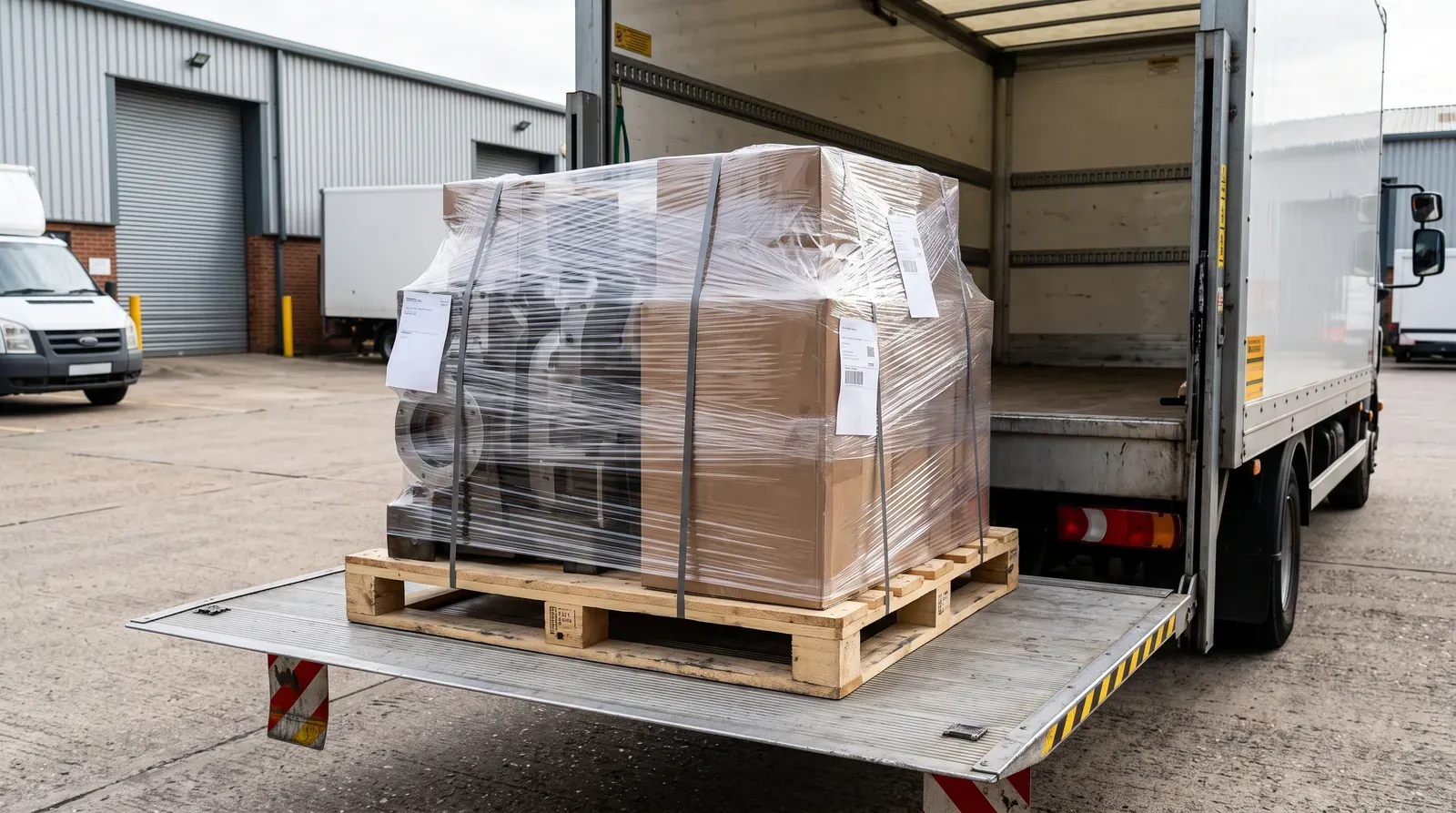
Securing dense shipments begins with selecting a sturdy, unbroken wooden or plastic pallet that easily handles the cargo load without sagging. All individual cartons or machinery components must remain completely within the perimeter of the base, as overhang creates immediate pinch points during trailer loading. Heavy items belong squarely in the center of the base to create a low, stable center of gravity, while lighter support items sit on top.
Once arranged, the freight must be bound securely to the transport base. High-grade tension strapping made of polyester or polypropylene anchors dense items to the wooden runners, preventing lateral shifting. A generous layer of industrial-strength stretch film should then be wrapped around the goods, extending several inches downward around the base of the pallet itself to unite cargo and platform into an immovable single unit. Applying clear shipping labels, fragile markings, and handling instructions to multiple sides ensures smooth processing through transit hubs.
Key metrics to review before selecting a commercial freight provider
Choosing a long-term commercial logistics partner requires thorough evaluation of operational reliability rather than simply accepting the lowest quoted rate. Key operational metrics to examine include:
- On-time collection and final delivery fulfillment rates across target geographic regions.
- Claim ratios regarding cargo damage and the speed with which insurance settlements are resolved.
- Availability of flexible delivery options, such as tail-lift assistance and booked morning arrival slots.
- Digital integration capabilities for tracking updates and clear electronic proof-of-delivery capture.
- Transparent pricing structures that clearly articulate variable fuel surcharges and accessorial costs.
Small commercial shippers must also verify what standard liability protection covers. Basic statutory carriage rates cover shipments purely by weight rather than true commercial value, meaning high-value electronic or engineered components require supplementary freight protection. Selecting a provider that offers simple per-shipment insurance upgrades protects cash flow from unexpected losses.
Building sustainable operations through outsourced transport
Entrusting heavy cargo distribution to dedicated freight networks transforms how emerging small enterprises approach commercial growth. Relieving leadership of the operational, regulatory, and financial stresses of running internal vehicles preserves energy for core manufacturing, product sourcing, and client acquisition. Capital stays in liquid reserves, protecting the balance sheet during unpredictable market phases.
Adopting shared-capacity logistics turns transport expenses into a predictable variable metric directly tied to sales volume. As order volumes increase across various territories, shipping capacity scales effortlessly without requiring additional driver hires or expensive equipment upgrades.
Modern commercial shipping belongs to flexible, asset-light organizations that leverage specialized networks for maximum agility. Small brands that embrace collaborative logistics solutions secure the physical reach of nationwide corporations while retaining the lean efficiency necessary to succeed long term.